Saturday, February 9, 2013

Les Maudits: Amadeo Modigliani, Claim Soutine, Suzanne Valadon and Maurice Utrillo

Modigliani is not only a legendary artist for his disturbing, short and somehow pathetic life, but for his portraits with long necks and nudes. Even though they are I really liked the long neck paintings and sculptures (I specially liked the sculpture because it seems to be an ancient African piece of art); I found them really  innovative and pleasant to the eye. His nudes are realistic and pretty much beautiful, I didn't found them problematic or inappropriately realistic, but you can't please everyone, right?

Modigliani's 'Female Head'
I think liked Soutine's food paitings even though they are made in such a marvellous technique that it really looks like the food will eat you and no the other way round, and with quite vivid oil painting colours I usually like. Nevertheless, I really liked his 'Plane Trees at Ceret' because of its abstract yet understandable style.

'Plane Trees at Ceret'

Suzanne Valadon's life of lovers sort of remind to Woody Allen's Midnight in Paris's character Adriana (Marion Cotillard), a women that had affairs with pretty much every great artist of her time. Now, talking about her paintings... well, I din't like a lot her nudes, they seem to lack of something, but her painting 'Two Cats' is great (that those cats resemble my cat Puma has nothing to do with it, not at all)

'Two cats'
Valadon's son Maurice Utrillo certainly has the most lovable paintings of the whole course, and he even chose the spots of Paris that I liked the most myself! His paintings are cute, calm, peaceful and delicate, a quite precise and remarkable brushwork with oil. Hats off to him! He's surely my favourite cursed painter! Though it is a shame that people with so much talent decide to basically kill themselves with alcohol.

'Place des Abesses'


Wild Men of Music: Igor Stravinsky

Stravinsky's 'The Rite of Spring' is surely a bizarre ballet composition. The dancers movement far from being pretty or delicate, are wild and strengtheners, and sometimes really weird. I really liked how the whole corps de ballet follows the two protagonist in each movement they made, and I think the audience can really feel the rare chemistry the soloists have during the whole number.
I think this ballet expresses too much energy, craziness and passion. It may look sometimes ridiculous for some people, but somehow I feel that every step the dancers make has a congruency that makes the whole number a perfect piece of contemporary dance.

Picasso's protrait of Igor Stravinsky


I love Pina Bausch's choreographies, and this post reminded of her.

Madeline

I just loved to watched the 1952 Madeline cartoon. It reminded a lot of my childhood, when I watched Madeline on the T.V. every time Disney Channel showed it (of course it wasn't the 1952 version, but the 1990s one).
1952 Madeline cartoon features not only one my favourite character of all time, but a great single animation style that indeed reminds us to Raoul Dufy's paintings, especially 'Belles Choses'.

Dufy's 'Belles Choses'
Ludwig Bemelmans's Madeline


Sunday, February 3, 2013

Salome Phenomenon

Certainly, Salome has been a great subject for artists to portray in either painting, literature, or even in opera. However, even though they all based their works on the same story of this seductive woman that wants the head of John the Baptist, it seems that each artist made its own interpretation and gave a different taste to the scene. Oscar Wilde, for example, portrayed Salome as a beautiful white princess that falls in love with a forbidden prophet, but as she is rejected, she dances to Herod only thinking of having the head of the man of her dreams; the thing is that, in spite of her obsession, madness, and monstrosity  Salome looks still like a tiny beautiful flower lost in 'love'. I think Wilde's scene is actually really similar to Moureau's painting 'The Apparition', in which Salome is portrayed as a beautiful woman admiring the prophet's head.
On the other hand, Richard Strauss's opera 'Salome' portrays a much more crazier and creepier Salome that looses any charm in her sick obsession. In this opera's final scene we never get to see a princess at all, we only see a crazy woman in a black coat adoring a dead man's head. I think Strauss's opera is basically  Beardsley's painting 'Salome with the Head of John the Baptist' set on stage. 

'The Apparition'
 
'Salome with the Head of John the Baptist'

Saturday, February 2, 2013

James Joyce - Dubliners

Of course, the five short stories I read from James Joyce's 'Dubliners' tell different tales that have nothing to do with one another; however, I have to admit I got practically the same taste at the end of each of them. 'A Painful Case', 'Two Gallants', 'Eveline', 'Counterparts' and 'An Encounter' all feature the same feeling of melancholia, loneliness, and misery in at least one of their characters, whether it is and old single man, a young man that hasn't achieve anything in his life, a young girl that can't escape from her ugly and boring life, an alcoholic that lives frustrated with his life, or a schoolboy who despises his own friend. All the stories seem to me sadly realistic. I would like to say that  Joyce is taking a too negative point on life in his stories, but he's only narrating some episodes that actually happen in the real world, nothing more; he's being too negative, nor too optimistic, he's just narrating life as it is. 
The main characters of each of the stories have some characteristics I like, and some others I can rather despise. For example, Mr. Duffy can be said to be a honourable man that hasn't done anything wrong, but he's too miserable to let himself live happily; he was miserable and had a chance to change that, but he didn't want to change his nature at all. Corley is basically the type of man I've never liked, and Lenehan seems to me just a sheep following Corley everywhere, but at least he knows his life has no point by now. Eveline is critical thinker, and thinks about the implications of her actions; we could think that she's weak for not leaving her life and going to Buenos Aires with Frank, but maybe she was stronger for refusing to change a miserable life for a even more miserable life with a man that, at the end, she doesn't love. Farrington is a lazy and weak man that can't face life without drinking, and has nothing to look up to, but his problematic sense of humour. Finally, the arrogant schoolboy narrator who had been despising his friend Mahony the whole story regrets having those negative feelings towards him. 
Overall, 'Dubliners' are some great realistic stories that can open more your eyes to what real life is. 

Chicago School and Prairie School architecture

The Chicago School and the Prairie School produced some great buildings; they are certainly beautiful and perfect each on its own way, but after seeing Art Nouveau, I have to say, these two old architecture schools didn't quite amaze me. Art Nouveau causes much more in me. 
Nevertheless, I think it is wonderful that great architects designed not only skyscrapers or big buildings just to get some fame, but small and ordinary buildings -I say ordinary because every city needs a bank, a library, a school or a store- that make a city not functional and beautiful! Nowadays, we just get 'cookie-cutter' buildings that do not have any artistic feature -or any feature at all-, and I think it is kind of sad what we're doing to our cities.

Art Nouveau: Germany, France, Belgium, Italy, Scotland, Russia, Spain

Germany's single protagonist, Hermann Obrist, is certainly really different from the other artists that lead Art Nouveau and usually make rather colourful compositions. However, his somber style is just great in its unique way. The curves that constantly feature his works are amazing, and they indeed give a feeling of being part of nature at the same time they still look dark and mysterious. By the way, I think August Endell's contribution to the façade of the Atelier Elvira building was a really nice one, it really suits Obrit's style and it just fits in the right place. 

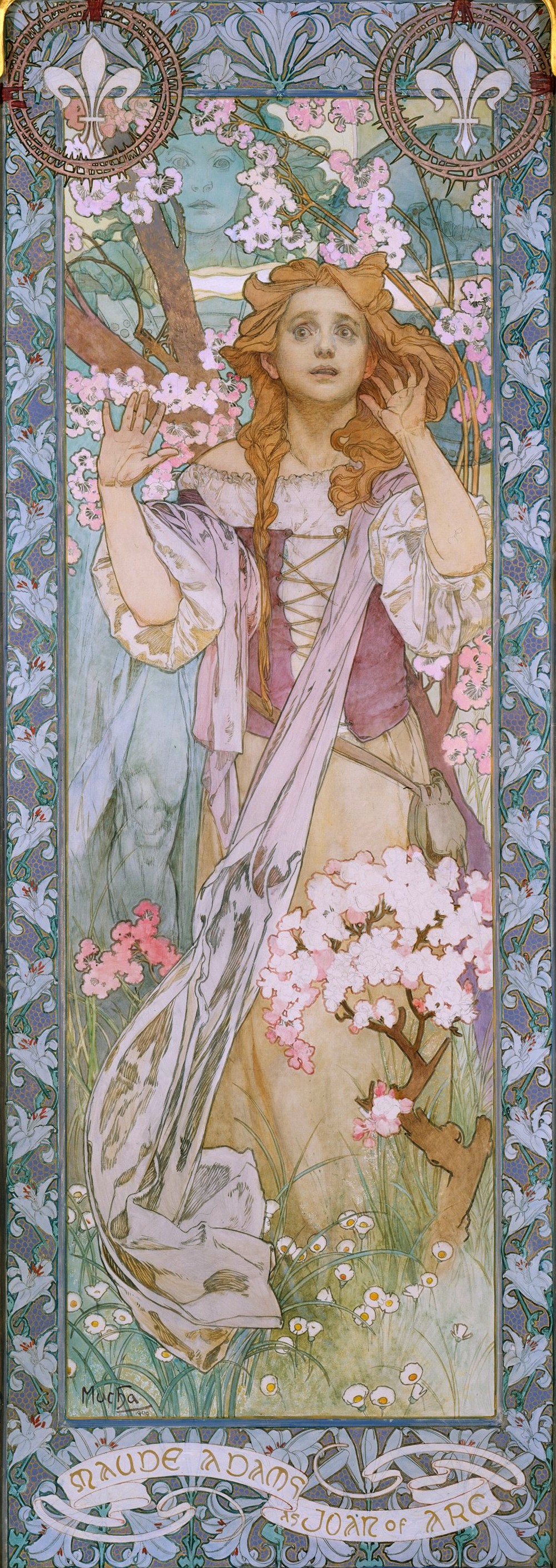
Mucha's 'Joan of Arc'
France is just an explosion of Art Nouveau: Alphonse Mucha, Emil Galle, Rene Lalique, Eugene Vallin, and Hector Guimard don't fail to make Art Nouveau one of the greatest movements of all art history. First of all, I have to admit that all I could think about while seeing Mucha's posters was: Now, THESE are REAL posters! In fact, they're some good examples of beautiful publicity; they're noticeable commercial, but they're still sublime and fine art. Mucha's work is a really interesting phenomenon, and I really liked how he could even mix realistic illustrations with rather fantasy-like elements or backgrounds (as in 'Joan of Arc'). Galle and Lalique really impressed me. I'm purely amazed! Art Nouveau produces too many emotions in me! I loved every single piece that these two guys made and I want them all for me! Now, I think Vallin's and Guimard's work are some really beautiful pieces of furniture; I'm not sure if the chairs are comfortable at all, but I would definitely buy them. 
I've always liked this metro entrance! When I was in Paris
last summer, I just went crazy of joy whren I saw this metro enrance!
It's just magical to me! Thanks, Guimard!
Horta's interior
I feel really guilty for being in Belgium and not getting to see Victor Horta's and Henry Van de Velde's work from which I've fallen in love! Horta's interiors just make me go WOW! I've always loved stairs designs and ceilings with lost of glass, so Horta is really special to me... his designs speak to me! What I liked about Van de Velde's works is that they can range from being rather weird, yet attractive compositions, to be more subtle or abstract pieces. 
In Italy, Giuseppe Sommaruga's fusion between Art Nouveau and monumentalism resulted, in my opinion, in a great work of art: the Palazzo Castiglioni. (The details of this building, actually remind me of Gaudí's Sagrada Familia's overwhelming details)
The Celtic Archibald Know did indeed some AMAZING works in metal and glass. I would like to have, for example, the Tudric clock on my room right now, and well, those vases would perfectly suit my living room, I want them all! 
The exteriors' designs of the Russian Fyodor Schechtel are clearly much more simpler than the interiors and exteriors of other Art Nouveau artists, but I think they are still remarkable and beautiful. His staircase in the Ryabushinsky House also reminded me of Sagrada Familia's perfect stairs! 
Finally, in Spain, in my beloved city of Barcelona, we have, in my opinion, some of the greatest works in the world. I spent a month in Barcelona last year, and I got to see A LOT of Gaudí and Miró, and of course, I went to the Sagrada Familia. Entering to this cathedral is probably the most unique and spiritual experience I've ever had! It truly left me with no words! It is inexplicably perfect! I usually don't like churches, cathedrals or basilicas, but the Sagrada Familia made me feel like anything else in the world... Just looking to its ceiling made my senses explode. I sat in one of the benches inside the cathedral for about an hour just to look at every inch of that perfectiveness  I don't believe in God, but I think that if he could could see that exemplary piece of art, basically in its honour  I think he will explode too, and make Gaudí his second son or the real God. I also went to Parc Güell and got to see some other buildings designed by Gaudí on the streets of the city, and think Gaudí's work cancels any other architectural attraction in Spain. Barcelona is a really magical city; I'll always have it in my heart! 

Sagrada Familia's nave roof. The greatest roof in the world!