Epic is a huge topic. It's epic. This time, I chose to talk about epic films. I guess the most easily recognizable type of epic films are those fiction and western long films, but I think epic can be more than that. For me, 'epic' is any film that creates a huge and elaborate set on a studio or outdoors to film even a small scene. For example, I think 'Singin' in the rain' is epic just for creating that extremely beautiful and realist stage for the 'Singin' in the rain' song scene.
In the same way, I consider the 'Wallace & Gromit', 'Fantastic Mr. Fox', and all those kind of animation films really epic. They created a whole world for little Plasticine figures to make a movie! It's amazing what people are capable to do in these films! I'm a fan of them!
Stanley Kubrick's 'A Clockwork Orange' is not only epic for its alarming story, but for the scenery and ths one-point perspective shots Kubrick used during the whole movie. It's epic!
Nowadays, people could also say that movies like 'Mission Impossible', 'James Bond' and such are also epic for the amount of special effects and all the action involved in those movies. But I don't think they can beat the old Clint Eastwood's epic westerns. I think it is more difficult nowadays to decide which films are epic and which films are not since now we can easily produce awful films that feature thousands of extras, memorable battles, huge studio stage productions, thousands of special effects, and such that can make a film look epic when it isn't. Mission Impossible, for example, features grand scenarios in the mysterious Moscow, there are a lot of epic special effects, memorable fights, and I have to say I really like that movie, but I don't know If I can qualify it as 'epic'.
Musicals are also something I'm really familiar with because I love them both theater and film. For example, I love Cabaret, Chicago, Moulin Rouge, Les parapluies de Cherbourg, The Rocky Horrow Picture Show, Singin' in the rain, The Blues Brothers, everything! In any style! Classic, Modern, Rock, anything! I couldn't possibly choose a favorite musical, I can only say that I prefer musicals that actually have a plot, not just an assemble of different musical numbers.
Musicals are indeed kind of magical (even if their subject-matters are rather realistic)... nobody sings that much in real life, huh? They're such a razzle dazzle!
A few years ago, the ISIC brought a rock opera called 'Frankenstein' by José Fors and I must say that's one of the most amazing experiences I've ever experienced in a theater! I was so astonishing! And recently, we went to the theater to see Mozart's 'The Magic Flute'.
(I think Cabaret is a perfect example of Magic realism because of the Emcee's relationship with the main story)
Animals have always been a huge part of stories (whether they're for children or for adults). Animals can appear as cute creatures or as wild an evil ones. For example, Winnie-the-Pooh is a lovely, yellow, and fat bear that eats honey! (Who can resist that sort of cuteness?!).. or Oswald, the lucky Rabbit... or Mickey Mouse... who doesn't love those animals?. In contrast, we could read Patricia Highsmith's short stories about pigs killing their owners, and we wouldn't like to be near a pork ever again!
Animals could also be treated as humans with an equally attractive effect. For example, we have Babe, the pig, or Wilbur, the pig, from Charlotte's Web, or Stuart Little, the little human mouse.
I think that no matter what approach you give to animals in a story, they always give a special touch to them! And animals are some of the characters that people always loves and remembers! Tweety, Tom & Jerry, the coyote, the road runner, Mickey Mouse, Donald Duck, Daffy Duck, Box Bunny, Goody, Felix the cat, etc. are always in our hearts!
Children's books
Children's books -usually featuring animals- are some great pieces of literature that people usually underestimates. It's true that children's books may not be a Borges' narration, but they are still great and memorable Besides Where the Wild Things Are and Winnie-the-Pooh, I would also mention The Little Prince, Alice's Adventures in Wonderland and Babar, the Elephant as some of the greatest books for kids (at least they were for me! I'll never forget them!)
Magic realism is something that I've been in touch a plenty number of times. Gabriel García Marquez, Jorge Luis Borges and Julio Cortázar are some of my favorite writers of the Spanish language. Their stories and novels are not only beautifully written, but pretty astonishing (especially their endings!). In my mind and heart, I treasure Cortázar's short story 'Axolotl', in which the narrator eventually turns into an axolotl (A Mexican salamander that lives in the lake of Xochimilco in Mexico City). It's pretty dazzling!
Borges' poems, whether they belong to magic realism or not, are sublime! He's my favorite poet in the whole word... Nobody can reach the perfection that he gives to the Spanish language (I even have a poster of Borges!)
'Rebellion' is a ridiculously big subject. A ridiculous number of bands, musicians and songwriters are mentioned here, and even though they all have been influential at some point, I'm only going to mention those who really appeal to me and, of course, the ones I think have left the most important legacy.
When we're talking about pure rock, I think most people think of Elvis, The Beatles, The Rolling Stones, and Bob Dylan, every other band is just a derivative from them... they're the ones that have really started it all.
Elvis Presley, the King of rock and roll has had, in my opinion, an incredible and HUGE influence, even nowadays everyone knows about Elvis, either as the sex symbol dancing bad boy or as the old and rather fat king of rock and roll. Even a small kid has listened to Elvis! Elvis is everywhere, even in Disney Channel's movies (I think the first song of Elvis I heard may be 'Suspicious Minds' in Lilo & Stitch). Of course, Elvis's influence isn't just his appearances on movies and such, I think he basically created the image of rock and roll, he made it danceable, catchy, rebel and catchy, surpassing the limits of jazz.
No other band has ever reach the musical career of The Beatles, year over year of success, eclectic albums that show not only the great musical talents of John, Paul, George and Ringo, but the constant maturation of the band in both originality of the music and the lyrics of the songs. I think no other band or person has ever have The Beatles' scope and constant success. They're a band that defined not only music but a whole era. They formerly started the concept of a 'rock band', being loved not only by the screaming female teenagers, but by a wide range of public. Who doesn't love The Beatles, anyway?
The Beach Boys are known as the American equivalent of The Beatles, but I think they're far away from that. I do enjoy 'I Get Around', 'God Only Knows', and 'Wouldn't It Be Nice', but we have to face they're just not The Beatles, I don't think The Beach Boys had such an evolution in the deepness of their songs as The Beatles.
Bob Dylan, maybe not as famous as The Beatles, but equally important, open the doors of a much more deep rock and roll with his epic song 'Like A Rolling Stone' (The Rolling Stones took their name from this song? I've always asked myself that...). Songs of more than 3-4 minutes were unthinkable for a rock song, and even more if it wasn't a girls/love song! Bob Dylan marked the beginning of something huge, even The Beatles must be thankful to him...
Ps. I love when he combines the harmonica in his songs. Blowin' in the wind is huge to me!
The Rolling Stones, The Who and The Doors are not my favorite bands or rock, but I can't ignore the fact that they're an icon of rock too, specially The Rolling Stones and Mick Jagger. Who doesn't know about Mick Jagger and his moves? Who hasn't seen that red tongue of theirs? They're huge but not that appealing to me. I may be wrong but I think The Beatles, Elvis and Bob Dylan are better than them because they DO sing, I think Mick Jagger rather screams... (Unlike Queen... Freddie's Mercury voice is just unique)
Much more later, yet influential and REALLY important rock bands are, of course, Queen from 70's and Soda Stereo from the 80's/90's (I think Soda Stereo is the most influential rock band from Latin America)
In Mexico, we have 'El Tri' and 'Caifane', but again, they're much more later rock bands.
(A clear influence from Bob Dylan here) - 70s
(The contemporaries of Soda Stereo) - 80s/90s
Maybe the mos 'Rebellion' ones are 'Molotov', a Mexican Rock Band that has even been banned by the national television channel 'Televisa' (These examples mix rap and rock)
I don't know what to think about all this divisions and classifications on Jazz. I don't a lot about music, but I know I like any kind of Jazz. Bebop and cool jazz doesn't seem really different to 'normal' jazz. Afro-Cuban Jazz and Bossa Nova-Jazz compositions are distinguishable from other Jazz songs, of course, but overall is all equally delightful to me. I guess that Sinatra couldn't sing to some Cool Jazz or Bebop songs, but they're still great to me. *Hats off to Jazz*
All I could think about while watching the 'Beat' films is that they look like some early Surrealist films (Un chien andalou, for example). The shots and especially the edition of the Beat films is kind of dazzling and it just doesn't feel real to me, I got a much more Surreal and nonsense taste with them. This doesn't mean, of course, that the films are bad. In fact, I love Surrealist cinema, and thus, beat films aren't bad at all. However, I don't think they quite impress or delight me... they're quite plot-less and somehow meaningless to me.
I read some of each author's poems. I found them really delightful... All Robert Creeley, Robert Duncan, Charles Olson and Denise Levertov have a distinctive and different style that stands out in a certain way, but personally, I think the poem I enjoyed the most were those written by Robert Duncan (an I'm not really a poetry reader).
"
1)
Drunk with love! now
I am poisond with love.
I have been subtly poisond.
Who would have thought pain so enduring?
The saxophone, the beat, the moon:
if I could only drift
once more toward foolishness
my angel, my angel
where have you gone? my false angel!
How I long for even the betrayal of your arms.
2)
Take away love,
this is the food that has poisond me:
if I had died
two months ago it would have been good.
I had faith.
Now there is no good thing
untainted.
3)
against the idea of suicide:
This is not what I want
to die in such misery."
As I've said before I don't really like too much poetry, but I love when poems seem desperate and passionate, there's nothing better than that in poetry! (Besides Borges and some other Spanish poets, of course - I prefer poetry in Spanish, I think not even French can caught the beauty of poetry like the Spanish language-)
I think stand-up Comedy is one of the greatest legacies of this time period, and again, stand up comedy is generally another form of social and/or political criticism that gets really close to the public. I think nowadays it is easier for the general public to remember a good stand-up comedian than a good painter, maybe because the interaction between a stand-up comedian and the public is much more direct and obvious than any relationship between the public and a painter or even a musician.
For the public, stand-up comedy could be seen as a relaxing and entertaining escape from reality, bur really they're just facing it in a more subtle and funny way. We can laugh of our own miseries with these guys, it's great!
I think an early example of stand-up comedy is the famous routine 'Who's on first?' (one of my favorites, my dad (both a film critic and a huge baseball lover) and I laugh ourselves out with this:
I want to point out the similarity between Mort Sahl's explanation of politics and John Cleese's explanation against Extremism:
Pure gold
I also want to mention Louis C.K.'s T.V. series 'Louie' as an amazing legacy of stand-up comedy (only that in the T.V. format)
I've always thought that criticism is one of the huge and most important subject-matters in art, specially in the United States and England.... It's just great, either it is a serious critic work of art, a comedy or a satire! I love when artists try to be socially aware because that gives their work a special feeling, a sort of extra, that is usually more approachable to the general public. I thin that 'Angry Young Men' and 'British New Wave' are just the perfect example of that. It seems that people just loved these plays, TV shows and movies, and they easily got identified with them. That's why South Park and The Simpsons are now just a big hit!
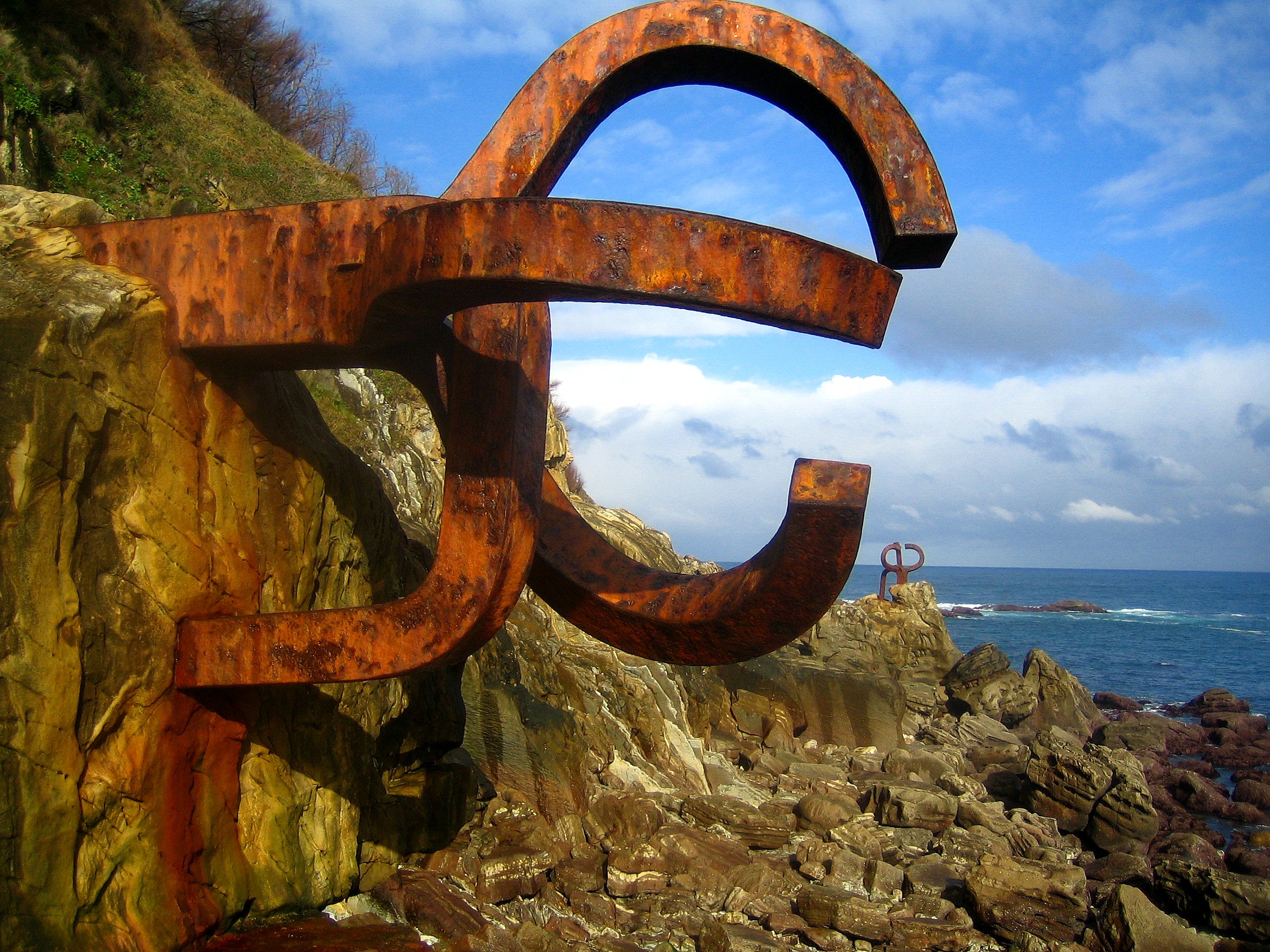
All I can say about Abstract Sculpture is that it seems so monumental to me! Even if they're tiny sculptures, they just seem so grand to me! They don't represent exactly any thing that we could recognize, but they can hypnotize us with no problem. I feel like I could lie in the sea just to watch the sculpture above! Abstract sculptures had made me remember that in spite of everything we do wrong, the human being is beautiful creature just for being able to create this kinds of things.
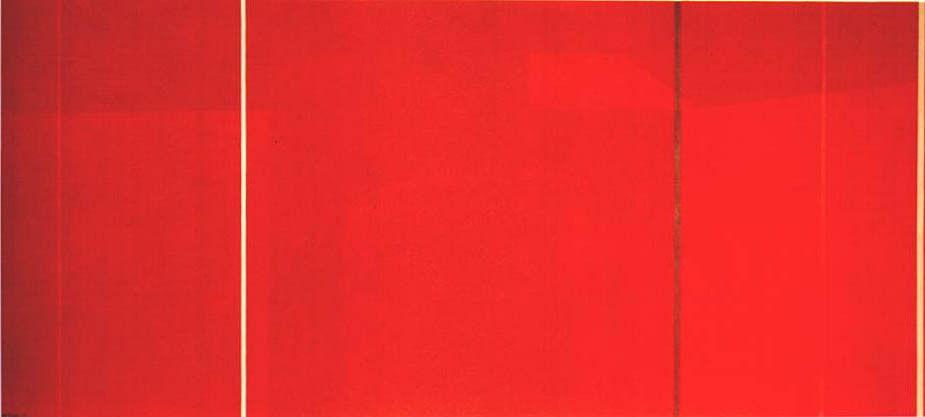
I wouldn't separate color field painting, post-painterly abstraction from abstract expressionism.... I think it's just stupid because all of those movements are abstract and expressionist. What's the point of separating them? If we take Mark Rothko's and Barnett Newman's 'floating rectangles' and 'zips', for example, we can easily see that they literary made color field paintings, but I think they're just as Expressionist as the finest Pollock's; color field painters throw us the same mystery and emotions with their canvases! Even an Ad Reinhardt painting hides something in his monochrome canvases, even an Yves Klein's blue canvas has something to say! (even if his paintings are just a blue canvas, we can't ignore the fact that he 'invented' his own blue, how about that?)
In the same way, I think Post-painterly Abstraction (silly name) is just as Expressionist as a Color field or an Abstract Expressionist canvas. It is true that Post-painterly canvas seem rather empty compared to a Pollock's or a Rothko's, but I don't think that makes them more superficial or meaningless.
What I would accept to separate from Abstract Expressionism, Color field painting, and Post-Painterly abstraction is Hard-Edge painting... It is just not the same to see a free composition of biomorphic lines, curves and figures that a Hard-Edge strict painting! However, I think that Hard-Edge is just as important and REALLY influential nowadays; it may not be as obvious in painting or architectural mediums, but it IS in modern design. This is obvious, for example in the modern MWM Graphics (Matt W. Moore). I love them!
Geometric abstraction and Concrete art VS. Tachisme, Art informel and Lyrical Abstraction is, for me, just another cliche of art history: some people is painting in this way, and after a while, another group starts to paint in the opposite way. Art is an action-reaction thing. I couldn't possibly choose whether I prefer geometric or biomorphic abstraction because I really enjoy both styles with some exceptions, of course. We could say that geometric abstraction is more common today in design (like the MWM Graphics I've mentioned before), but biomorphic abstraction is still present in our furniture and design too, so I've decided to don't take a side and enjoy both styles.
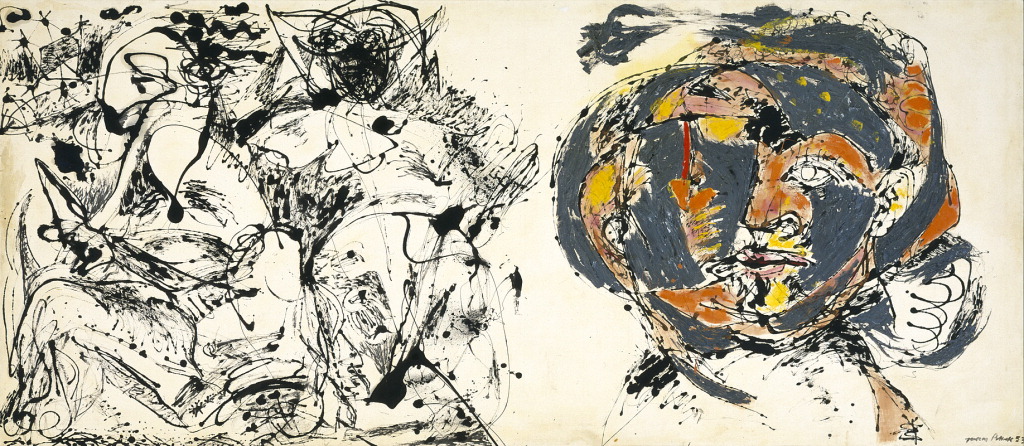
Abstract art is usually underestimate by the public; people think that Abstract Expressionism paintings are a sort of farce... "I can do that" they think... "My son made that in kinder garden" they say... "That's not art" they affirm. I think Abstract Expressionism is just the perfect movement to argue just the opposite. We could think that Jackson Pollock, for example, just spilled painting in a large canvas, but his paintings have actually a unity in both the 'lines' and the colors... It can be easily seen that he controlled the painting and maybe it is just me, but I can feel that Pollock had a kind of special relationship with his works.
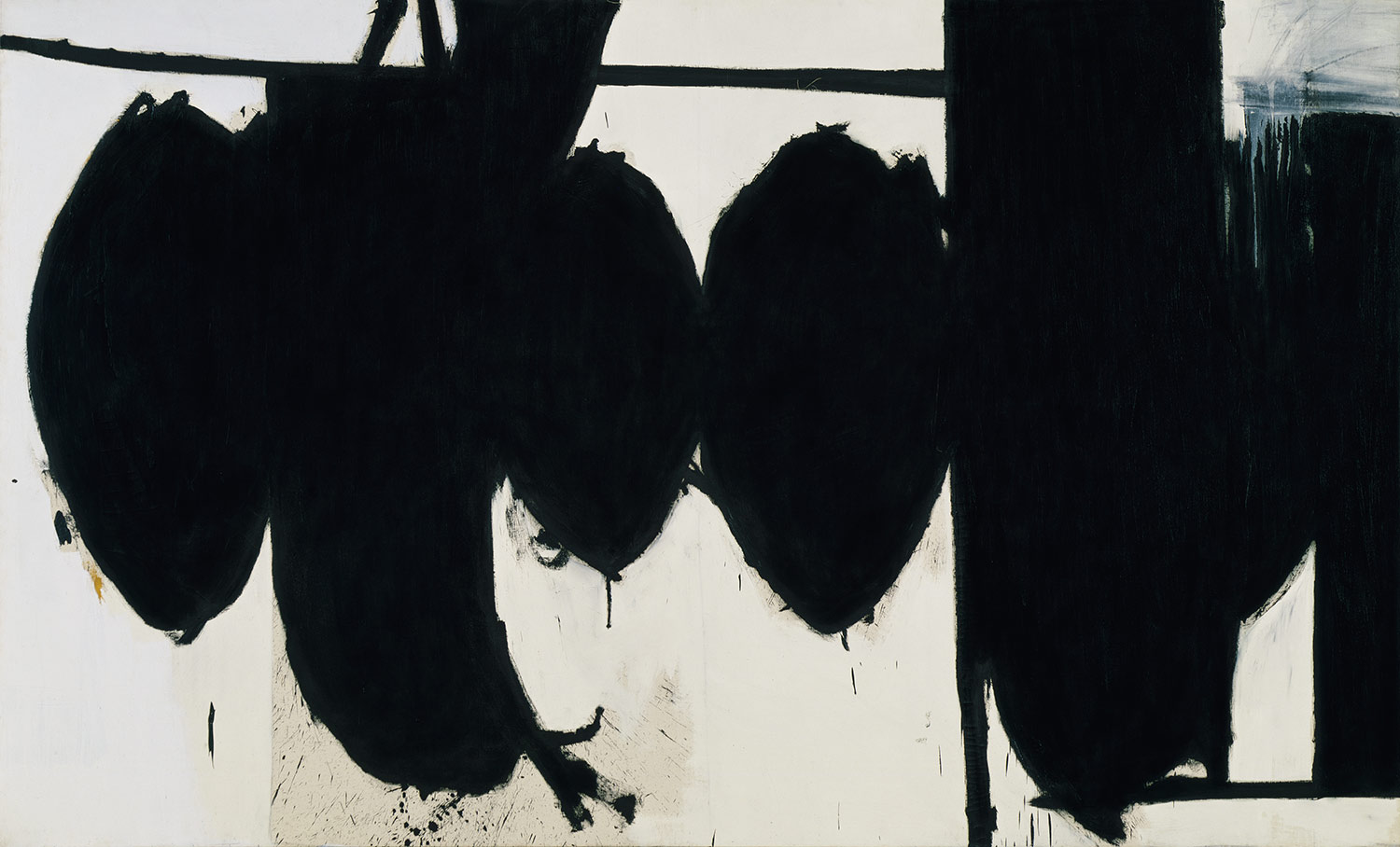
I could feel the same phenomena with other Abstract Expressionist painters like Willem de Kooning, Franz Kline and Robert Motherwell. They just seem so attached and related with their paintings! It's amazing and kind of special too... We couldn't find any painter-painting relationship in an old Venus painting from the Renaissance or even if we could find a relationship between the author and his/her work in Impressionism or surrealism, it wouldn't be as obvious as it is in Abstract Expressionism... I think this happens for the fact that we can actually see the work of the abstract Expressionist painters in the canvas (the shoulder movements of Pollock, for example).
Personally, I've always enjoyed abstract paintings that actually cause an emotion in the public, abstract paintings that seem to be telling you something, works that actually speak to you... I think Abstract Expressionist accomplished all that... *hats off*
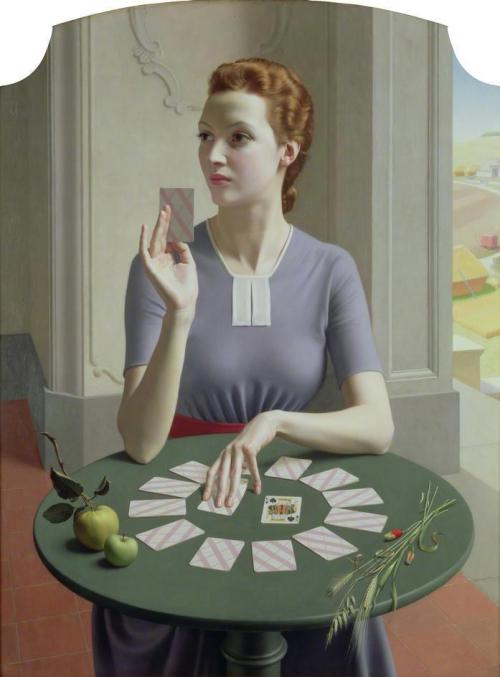
I guess that Uncanny paintings is something natural to happen after the war. Artists wanted to be Realist or even Hyper-realist, but sometimes that obsession for Realism turned actually pretty strange; familiar but strange; familiar but mysterious; familiar but too perfect to be actually real. I've always liked Uncanny paintings because even though they portray things pretty much as they are without any dream-like atmospheres and such, there's always a sort of Surrealist feeling on them, and I love that!
This time, I think that Meredith Frampton got the trophy of uncanniness. Her paintings are certainly beautiful and breath-taking, but I guess she made life look way too perfect (something not quite realistic).
I just have on word for Body Ugly paintings: wow! These paintings surely are UGLY! If I was to choose what specie to be and I saw those paintings, I would never choose to be a human being. It's true that the human body can turn not that appealing to our own eyes, and well... I guess these painters don't want us to forget that fact. I would never but those paintings, and I don't get why someone will choose to paint that, but we can't ignore these painters had a great talent and well, of course, a real distinctive technique and style... really REALLY GROTESQUE.
Paperback cover illustrations considered as art is something really interesting... I'd never thought of those images as actually art, but they totally are; just because they're not on a canvas in a museum, that doesn't mean is less valuable or more artificial. It's sad, of course, that these artists get most of the time unnoticed, forgotten and underrated. I think that it is really interesting when books feature this type of images on their covers because they can give you an idea of the plot and the atmosphere of the book you're going to read.
Street art is always criticized and somehow underrated, but I think that some of the best works of art come from street artists. Talking about photography, we could say that street photographers were more aesthetically concerned than the pure straight photographers even if they didn't use any effects or edition as well. However, I don't think there's much more difference between any of the photographers I've been discussing in Postwar Realism... Straight photographers also worked on the street and portrayed social and historical conditions and events involving people from all social classes, and even if they were more prepared and famous than the street artist, that doesn't mean their art is more valuable (the prices can differ from this idea, though).
As nature allows photography to be perfectly straight, it also makes it automatically artistic and appealing to the eye. It may seem easier to make nature photos because they mainly consist on landscapes and still-life photographs that do not require movement manipulation, but I guess the difficult part is the time. For example, if you want to take a photograph of the day turning into the night, there's a small interval of time when that happens and you have to work quickly and adjust yourself to other things like the weather conditions (no sun can be tragic for some photographs)
I think that war photographers should be admired not only because of their work (which is great: straight but artistic), but because of their courage... I would never go to a D-day just to take photographs even if I get a million of dollars. It's just crazy! Going to the locations after the battle passed would be depressing, but I'd rather go after the battle than actually being there when the action is happening just to take a bunch of photos! I guess that's something we can admire of these people apart from their work!
These war photographs seem to me more spontaneous and certainly more improvised than the other photojournalist photographers covering floods and the Empire State Building, and I guess that's because these war photographers had to keep moving in the field and there's not actual time to tell a solider to hold in one position to take a more controlled image... The results are great, though. *Hats off*